I didn't know John Murphy personally, but I know people who did. The words that have been written about him since his death are eloquent of a warm and generous man. (This notwithstanding an outward appearance that you might think would send small children running crying across the road to the other side if they saw him headed in their direction.) But I will have to leave personal eulogies to others.
His music, it's probably fair to say, ranged far and wide, and frequently in directions that many listeners would choose not to follow. But he was true to his own vision, and it can never be said that he did not at all times maintain his integrity as a musician.
One of the many records that Murphy appears on, and one which forms a large part of my own DNA, is the self-titled EP by Whirlywirld, which was one of the first seven-inch records I bought upon graduating from children's records. I don't know now what possessed me. (Maybe it was the jetsetting glamour portrayed on the front cover.) It has, though, stayed with me, like Old Faithful, protecting the back end of my shoebox of (alphabetical) seven-inches ever since, getting dusted off every so often for a rewarding spin. "Window To The World" is the A side.
Bonus beats: if you only know one thing about Whirlywirld it will probably be "Win/Lose", which was a staple of 3RRR in the Good Old Days.
Recently I have been on a major Pizzicato Five kick. Probably this is not unrelated to the fact that the fifteen-year-old has spent the last two weeks in Japan, sending back infrequent and cryptic messages along the lines of "I bought this thing, I don't know what it is, I don't know what it's made of, but it's REALLY COOL". (I suspect he has, right there, summed up Japan for the non-Japanese in one easy sentence.)
But anyway it is always nice to revisit Pizzicato Five. There are always hidden surprises. Like this song. Its title, "Icecream Meltin' Mellow", almost perfectly encapsulates the sense of bitter-sweet melancholy that lies within its grooves. That's a pretty neat trick, given that English is not their native language. Plus, the song has everything over its six-and-a-half minutes: reggae grooves; scratching; rapping; and a full-on disco string section. What could possibly go wrong?
As good a song as "Atlas" was (and still is; remind yourself), I have to admit that my love for Battles -- and love it certainly is -- has been somewhat qualified. "Mirrored", it is perhaps unfair but (for me) honest to say, suffered from not being "Atlas" x 10. Then, with "Gloss Drop", they were finding their feet as a trio, and the guest vocalist thing didn't quite allow for a solid end-to-end listen. (Props for putting Gary Numan to good use, though.)
Now they return with "La Di Da Di", and, by Jove, this time I think they've done it. This album is rock solid. No one track particularly stands out, and it may be a little on the long side, but with playing this good, and ideas this inventive, it's not that hard for the listener to stay focused. And it all works.
Plus, John Stanier must be the most efficient yet effective hitter of things since John Bonham and John McEntire. (Hey, look, it's the Three Johns.)
I'm throwing you the opening number, not least because at one point it adopts a fairly convincing reggae gait. (And partly because of the existence of this clip, of a live-in-the-studio version, which gives you a good idea of what they are on about; and with this kind of somewhat (let's be honest) academic rock music it can help to be watching what's going on.)
Like Neil Young, Bob Dylan and Richard Thompson, Ed Kuepper spends a lot of time revisiting, and reworking, his back catalogue. (I don't even know how many versions of "Eternally Yours" I own. You might say "too many". You would be wrong.)
Unlike at least two of the others, though, he has never taken the edge off that back catalogue by insisting on putting out an album of new material every year or so. In fact, Ed hasn't put out an album of new material since "Jean Lee And The Yellow Dog", in 2007. (News flash: a new Ed song, "Never Too Late", has just appeared, on the soundtrack album to "Last Cab To Darwin", along with an album's worth of instrumental swatches.)
Not that we have been starved of material in the interim. The revived Prince Melon Records has been working hard on a significant but elusive "Bootleg Series" of mostly live recordings by Ed, The Aints, and The Laughing Clowns. Meanwhile, two albums of "new" Ed material have emerged on CD in the last few years. "Second Winter" is a kind of alternate take on his early solo albums, sparse of instrumentation and heavy of atmosphere. Then last year he put out "Return Of The Mail-Order Bridegroom", another solo recording of older Ed songs and with a few covers thrown in (he bravely takes on "No Regrets", and wins).
The highlight of this album, for me, is "the return of" a couple of Kuepper/Bailey songs, from the time when dinosaurs really did still walk the earth. "Brisbane (Security City)" is from the third Saints album, the one where Ed started driving in a different direction from Chris Bailey. (Not coincidentally it was also the final Saints album to have Ed on board.)
"Messin' With The Kid", though, is why we are here. It stood out on the first Saints album, "(I'm) Stranded", for being something other than a three-chord maelstrom. As with Lennon/McCartney (or Forster/McLellan -- actually not so much with the latter), the joint songwriting credit can make it a bit difficult to discern whose songs are whose, but in later years, especially since the gradual rapprochement between Keeper and Bailey, Ed has reclaimed the song as his own, which possibly answers that question.
(As further evidence, in the intervening years Ed recorded, for the "A King In The Kindness Room" album, a song called "Messin' (Pt II)", which is musically pretty close to "Messin' With The Kid", but with different lyrics. It is instructive to play them one after the other. They are both fine songs.)
The original "Messin'" was full of the pent-up frustrations of youth. The version on "Return Of The Mail-Order Bridegroom", which was recorded a mere 37 years later, and which I have uploaded for you here, for a short time, and as long as nobody minds, demonstrates that it is a song that can outlive youth. Ed here drapes it in adult clothes, with an air of melancholy, of nostalgia, perhaps, for a couple of frustrated kids on the streets of Brisbane in the mid-seventies.
"Put Your Arms Round Me (Stereolab / The High Llamas Remix)", by Todd Rundgren, Emil Nikolaisen and Hans-Peter Lindstrom.
[Photo contest: match the dog with its owner. Answer: they are probably all Todd's. Photo via Stereogum.]
Is it possible for the most confounding album of the year to also be the best album of the year?
We may be about to find out. "Runddans", a collaborative album by His Royal Toddness, the guitarist from Serena-Maneesh, and the King of Space Disco, is a fascinating and uncompromising listen. Like Nicolas Jaar's "Space Is Only Noise", or Flying Lotus's "You're Dead!", it is not so much a collection of songs as one contiguous suite arbitrarily broken, for convenience of searching, into individual tracks, but it should really only be heard as one uninterrupted slab. (If you've come to this from Todd, you know to expect the unexpected. If you've come here from Serena-Maneesh you will be gratified by the occasional outburst of shredding. If it's Lindstrom wot brought you here, be aware that this is more "Six Cups Of Rebel" than "I Feel Space". (Disclosure: I was a big fan of "Six Cups Of Rebel" from the minute I first heard it, and was surprised to discover that it was generally received as a steaming pile of ordure.))
If the album has a centrepiece, is would be "Put Your Arms Round Me", as close to Rundgren's pop mastery as the album gets. (It was also released as a single, probably a smart (but misleading for the unsuspecting) move; though it does important work in the the album's singular trajectory, it is also capable of having a life of its own, untethered from the rest of the album.)
I have been listening to the album, front to back, on my regular walk (it is the exact same length), at considerable volume, and have found a way, if not exactly to figure out what the hell is going on, to at least allow it all to wash over me in a somewhat leasing fashion. I wouldn't have thought it was a candidate for today's de rigueur fashion accessory, the remix ep. And yet here it is. Erol Alkan, no stranger to the remix game, and one half of retro-futurists Beyond The Wizards Sleeve, pulls off the significant feat of distilling an undistillable album down into ten easily digestible minutes while maintaining something of the peculiar flavour of the original. EYE, and this will be no surprise at all, piles noise upon noise.
And then there's this. The "Stereolab / The High Llamas Remix" of "Put Your Arms Round Me". What the? Stereolab, the band of the 1990s, have been on hiatus (at the very least) for some years now; Laetitia Sadier is building a solo career and Tim Gane has been operating as under-the-radar as it would be possible for the music nerd's music nerd to operate (a forthcoming release on Ghost Box will surely put paid to that). The High Llamas, well, they have been quiet for a few years too. So what kind of beast is this? My first guess, without hearing the remix, was that it was probably just Sean O'Hagan at the controls, he being a sort of uncredited member of Stereolab during their golden years. But listen. Within the first seven seconds you are plucked out of your seat and thrown back to "Dots And Loops"-era Stereolab so completely that it actually comes as a bit of a shock. In fact, it is extraordinary. Nothing is going to bring Mary Hansen back, which only makes the sudden immersion into the sound of her era of the band that much more of a jolt. My new best guess, then, is that it is O'Hagan and Gane together who are responsible for this. Who was the genius (okay; it's Todd Rundgren: you know the answer to that one) who put this on the table and made it happen? We can only be grateful. As the song says, "I have waited for this moment ...".
Can I be honest with you? I'm getting a bit
tired of these monthly mixtapes. Not the end results; they always seem to turn
into something I would want to listen to. No, it's the endless trawl through a
seemingly bottomless pit of songs that sometimes isn't my idea of a good time.
(I see to be in a let's-listen-to-albums-from-start-to-end-like-nature-intended
phase. I'm sure it will pass.)
And yet we press on. Because we must.
"Africa", by Sathima Bea
Benjamin. Of course, we can ease into the task with a jazz number from the
mid-seventies that is held together by some very nimble percussion playing and
the kind of circular bass line heard on, say, The Birthday Party's "NickThe Stripper", or Min Bul's astounding "Champagne Of Course".
You will be so mesmerised that you will have no idea that 20 minutes have just
passed.
"Talking Central Park Blues", by
Ultimate Painting. Given that there's really nowhere you can go after as
powerful a song as "Africa", we might as well just move on to the
next one on the list. Which happens to be two English (at least I think they
are both from the UK; one is, anyway) dudes, both from other bands, riffing on
the Velvet Underground's "What Goes On" (and, of course, on Dylan,
with the title of the song). "What Goes On" is a
part of my DNA, so of course I am going to go for this.
"Moonquake Lake", by Sia &
Beck. This makes no sense to me. Evidently it is from a movie. What is Beck
doing here? Being Beck, I guess.
"Inside-Outside", by
Embassylights. Information about both band and song is thin on the ground, or I
don't know where to look. (They would
appear to be from Calgary via Reykjavik.) Anyway, this is an easy song to like.
If it's the vocals that are perhaps curbing your enthusiasm, stick around: there
is a nice hint of Broadcast towards the end.
"Orange Romeda", by Boards of
Canada. Boards of Canada are the kind of band where it is always worth picking
up the crumbs. This particular crumb is only available on a Warp compilation
entitled, and I think this is a fair statement about the label (as least
through the eyes of the consumer) "We Are Reasonable People" (see
what they did there?)
"Late Train (Emperor Machine Special
Extended Version)", by Paqua. Some of the more recent output of Emperor
Machine under their own name has left me a bit under-excited. This 12-minute
remix shows they have still got it.
"Fried Neck Bones And Some
Homefries", by Willie Bobo. As (presumably) sampled in some old hip hop
track. This song is making me hungry.
"Swan Lake", by Blackalicious.
Speaking of some old hip hop track ...
"A Harsh Truth (Parts I &
II)", by Zurich. Zurich, as far as I can gather, was a one-off project
featuringNeil Halstead which took place
in the couple of years between Slowdive's "Souvlaki" and the
extraordinary final album, "Pygmalion". Halstead would go on to helm
the Americana-by-way-of-Dunedin Mojave 3, but this sounds nothing like that.
"Reve", by Vangelis
Papathanassiou. Even though this isn't taken from the "Blade Runner"
soundtrack, if you close your eyes you can practically see those rain-soaked
neon-lit streets, that once-majestic apartment building ... [sigh].
I will be very surprised if Colleen's "Captain of None" doesn't sit at the top of everybody's album of the year lists. Okay, not surprised. But disappointed. It is a wonderful album, brilliantly simple in construction, but emotionally complex. It somehow manages to convey both warmth and space, so that it would work equally well at a summer barbecue and around the fireplace on a cold winter's night. That's not as easy as you might think.
Essentially the album is a combination of viola da gamba and the human voice, embellished with a healthy dose of reverb and other effects. "Ah, Arthur Russell's 'World of Echo'", I hear you say. And of course that equally remarkable record provides an obvious touchstone. But listening through the album, you also hear other reference points: mid-seventies Jamaican dub (a melodica even appears on one track, confirming other, perhaps more ambiguous sightings); Forest Swords' inversions of the dub template; Virginia Astley's "From Gardens Where We Feel Secure"; and perhaps a little Penguin Cafe Orchestra. Not that "Captain of None" is merely a pale reflection of its lofty sources. It is a record that can, and does, stand on its own two feet.
It is on "Lighthouse" that the Virginia Astley and Forest Swords (and, I guess, Penguin Cafe) references are most directly felt. I think you will spot them.
"Lighthouse", in its recorded version, doesn't seem to reside on the internet. (I have put a copy of it here (right-click etc), to allow you to listen, and will leave it up for a couple of weeks, if nobody minds.)
I did, however, find a clip of Colleen in performance; she somehow manages to convey the vibe of the original; it is perhaps instructive to watch it happening in real time.
Max Richter has just produced an eight-hour piece of music entitled "Sleep", designed to be listened to, presumably osmotically, during that process (and a one-hour distillation of same for those of us who prefer to listen). Not satisfied with that, he has also, and apparently for the first time, tried his hand at putting together a mix. He is, as it turns out, a dab hand at that, too.
How is it possible to combine the likes of, on the one hand, Boards of Canada and Cat Power (themselves not necessarily comfortable bedfellows) with, on the other, Old Skool composers like Bach, Purcell and Byrd (that's William, not Donald) and youngsters such as Berio and Golijov, and end up with a seamless listen?
"Take My Heart (You Can Have It If You Want It)", by Kool & The Gang.
It might just be me, but when I hear the start of this song I can't help but think I'm listening to one of Jemaine's "let's make lerv"-type songs from "Flight Of The Conchords".
As a friend once said, there are not enough "O"s in smooth.
Yowsa, yowsa, yowsa. It's the October 2014
hypothetical mixtape.
"Mkwaju", by Mkwaju Ensemble. I
was attracted to this because of its affinity with other mid-80s flights of ethomusicology, such as the "Snake Charmer" EP. But then I discovered
that this song establishes that there is one degree of separation between
Yellow Magic Orchestra and Studio Ghibli. No, really. Joe Hisaishi, whose
project this largely is, has composedthe soundtracks for many of Hayao Miyazaki's films. Hideki Matsutake,
who did the keyboard programming, wasn't a member of YMO officially but did so
much of the programming for them that he probably should have been. Bonus: it
also kicks like Steve Reich in full flight.
(Available here. The link is still good at time of
writing.)
"I Pity The Country", by Willie
Dunn. Here is a, for want of a better term, country-folk song, excavated by the
estimable Light In The Attic, that tells it like it was in the seventies for indigenous
North Americans (in his case, Canadians) and, sadly, like it still is, and will
likely ever be.
"Ali Baba", by John Holt. The
first reggae reissue I bought on CD was "King Tubby Special", two discs of some of the best of King
Tubby's studio concoctions. One of the many standout tracks was called "I
Trim The Barber". Twenty-five years later, I finally, finally, stumble
across the original song from which this riddim (amongst many others) sprang forth. It still sounds fresh as a
daisy.
"Voyager Without Passport", by
Friedemann. Do you remember Fischer Z? Do you remember Propaganda? Do you
remember the sound of the guitar on David Sylvian's first couple of solo
albums? It's all here, improbably. Maybe with a pinch of Grace Jones added.
(Bonus: album cover of the month.)
"Everyday Just Another Dream", by
Naffi. This song certainly doesn't outstay its welcome. Songs like this one
were the reason the post-punk (anti)movement was so important in pushing music
forward. You couldn't have imagined a song like this existing on record in the
mid-seventies. Of the many doors that punk blew down was the one leading to
bands like Marine Girls and, through them, the indelible Weekend. (Also, for good measure,
... And The Native Hipsters, and Life Without Buildings.) That's the door that
these folk also snuck through, if only briefly.
"Los Ninos Del Parque", by
Liaisons Dangereuse. If I had heard this before I ever heard and fell in love
with DAF's "Der Mussolini", would it be this song that lives in my notional Festive Fifty? That, being a counterfactual, is
impossible to answer. But one thing I do know: I'm a complete sucker for that
early-80s arpeggiated synth-driven rhythm bed.
"En Hast Utan Namn", by Family
Four. Swedish pop group. Two males. Two females. Represented their country
twice at Eurovision in the early seventies. That's right: Family Four. What's
that? You were expecting, maybe, somebody else?
"Im Achtzigsten Stockwerk", by
Hildegard Knef. Backing vocals by Die Rosy Singers. (You could easily put a
comma in there. Just sayin'.)
"Nothing Serious (Just Buggin')",
by Whistle. AKA We've Got A First-Generation Sampler And We're Gonna Use It. I
wouldn't want to listen to this every day for the rest of my life but it's
hella fun before the novelty wears off.
"How You Got That Girl", by
Ex Hex. Power pop lives! Here they are playing it live, just like nature
intended.
"Last Ride", by Wildest Dreams.
You may think this is authentic southern fried boogie. I'm happy for you to
think that, but you would actually be wrong. Wildest Dreams is none other than
DJ Harvey. He did something similar a few years back as one half of Map Of
Africa, so it must be some kind of a thing with him. (Coincidence corner: DJ
Harvey has also remixed a song by Logic System, Logic System being none other
than Hideki Matsutake, see above.) (And yes, it's a long track, but stick
around for the wicked three-minute coda.)
"Why Didn't You Save Me (Dave
Harrington Remix feat Tamara)", by Nicolas Jaar. Let's revisit, for a
moment, my crackpot theory that your favourite artist remixed is never going
to grab you as much as your favourite artist remixing some other artist. This
is, on the face of it, an example of the former, but with a twist: the remixer
in this case is the other member of your favourite artist's short-lived band,
Darkside. Let's call it a draw.
"Our Love (The Juan Maclean
Remix)", by Sharon Van Etten. Whereas this lands firmly in the latter
category. It sits comfortably alongside the remarkable Ewan Pearson remix of Cortney Tidwell's
"Don't Let The Stars Keep Us Tangled Up". (That's high praise, in case you
were wondering.)
"Faux (Four Tet Remix)", by John
Beltran. As to John Beltran, I know nothing. But this remix is classic Four
Tet. Although it is also calling to mind something else: Chateau Flightmaybe? (Incidentally, the new Four Tet
album is needed in your life. Trust me.)
"On", by Aphex Twin. I have been
on a vertiginous Aphex Twin learning curve over the last 12
months. It's like a dam burst, a dam that I didn't realise had been built, let
alone was filling to dangerous levels. It all started some years ago, when I
found "Selected Ambient Works Volume II" second-hand and took it home
on spec, listened a few times, and put it aside. Much later, I picked up a copy of the 33 1/3 book about same.
Of course, last year, as you know, interest in Aphex took off with the release
of "Syro". That seems to have been the spark that I needed. (The Wire named it album of the year.) Meanwhile the
internet was sending me off down sundry rabbit holes, one of which led to the discovery of this song. "On" came out as a 12" shortly before the release of
"SAWII". That might, I suppose, be why I am partial to it. The heck if I know. I'm stuck down a rabbit hole. (The link is
to a somewhat shortened version of the track, but it gives you the
idea.)
"Natural Lifespan (Prins Thomas
Mix)", by Cos/Mes. As with the Four Tet, the original of this, if it even
exists, means nothing to me. We are here for the blissed-out Scandinavian funk
moves. (In saying this we mean no disrespect.)
You already know how we feel about Quilt's second album, "Held in Splendor".
They had a song called "Milo" on their first, self-titled album, which they seem to have decided was the one that they would turn upside down and shake the bejeezus out of, to see what would fall out.
It exists as a 26-minute freak-out on a two-song release self-explanatorily entitled "Quilt in Marfa".
Courtesy of Aquarium Drunkard, you can watch a more concise performance of the song. Hang on to your Canadian Mountie hat. It's a doozy. (The song. And the hat.)
"Don't Let Me Be Misunderstood", by The Costello Show.
One artist who is heavily represented on my vinyl shelves is Elvis Costello. "King Of America" is the last album of his that I bought in that format. At the time, I thought it was the "Stunning Return To Form" album, after the (I thought at the time) misstep of "Punch The Clock" (I revisited that album recently; it holds up surprisingly well) and the abject debacle that was "Goodbye Cruel World" (I think I was right about that one).
"King Of America" is an interesting record, but on reflection it is quite patchy, suffers as a lot of his later records do from bloat, and misses The Attractions (who only play on one song). The latter omission is pretty obviously intentional: you will look in vain for the name "Elvis Costello" on the album. This, I am guessing, is also a kind of conceptual con job: Costello, who, presumably in a moment of "punk rock" enthusiasm, took the name (in vain) of the "King" (see what he did there?) as an act of (presumably) rebellion rather than reverence, must have jumped at the chance to make an album with people better known for their work with the other Elvis. Perhaps he found it awkward, in those circumstances, to put the word "Elvis" on it; perhaps he wanted to distance his other self from the record (although if the latter, why put his instantly recognisable visage across 100 percent of the front cover? -- speaking of which, if you take away the hat and the Coke-bottle glasses, doesn't he look hipster a quarter of a century before the fact?).
We may never know. It is nevertheless an enjoyable, if overstuffed, record to listen to. But the song that stands out isn't even an Elvis Costello song. He takes "Don't Let Me Be Misunderstood", a song originally written for Nina Simone but made famous by Santa Esmeralda during the disco era (the version given a further lease of life by Quentin Tarantino), and turns it into a brooding and malevolent smoulder. A sneer is never that far from Costello's singing voice (which is why, when he eschews it, for example in "Couldn't Call It Unexpected No 4" or "The World And His Wife", it is so surprising, and life-affirming), and the faintest hint of one appears here, to great, if slightly terrifying, effect.
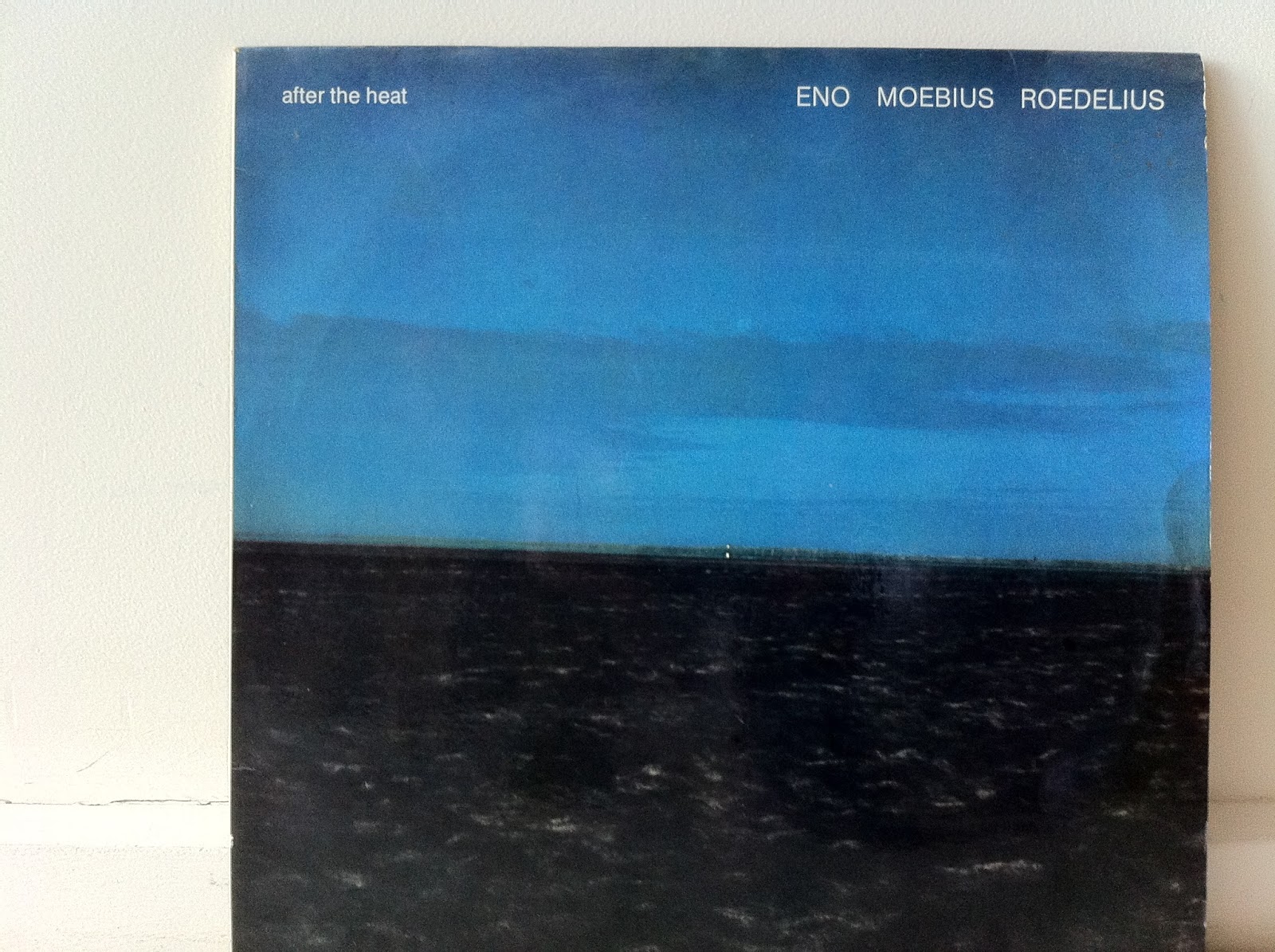
And so we pay our respects to German musician Dieter Moebius, who died earlier in the week. You will find plenty of worthwhile and knowledgeable tributes elsewhere; these are my personal thoughts only.
In my previous missive, I made reference to the extent to which Brian Eno has led me to other things. The music of Dieter Moebius was one of those things. During my early-eighties obsession with all things Eno, I must have found in a Melbourne record store a second-hand copy of an album called "After The Heat", labelled as being by "Eno Moebius Roedelius". Here is a photo of the record. You can see that it has been well worn.
At the time of buying it, I knew nothing about it. I also knew nothing of Moebius or Roedelius. (There was a time when all human knowledge was more than one click away.) Eno's name was enough for me. My early impressions of the record were, therefore, largely of bewilderment. I wouldn't say "disappointment", but as a mere boy I was only looking for concrete evidence of Eno, and that, I thought, was limited to his vocals on the final three songs on the album.
It wasn't until later that I became acquainted with the music of Moebius and Roedelius's earlier groups, Cluster and Harmonia. (I came to them through brief obsessions with Neu and Can, and also, I suppose, through discovering the album "Cluster & Eno" (the one with the cover photo of a microphone out standing in the field -- cue dodgy Dad joke).) Armed with all of this music, I was then able to go back and make a better fist of "After The Heat", which, when all is said and done, stands tall in the catalogues of all musicians involved (including the seemingly ubiquitous Conny Plank, who produced). Also, I was no longer clouding my judgment by trying in vain to find The Essence Of Eno throughout its grooves. I could let the music wash over me, as it was designed to do, and which it does to great effect.
"After The Heat" is, I would say, a fine example of pure collaboration. Sure, you have Eno's voice, which no matter how much you try to disguise it (including, on "Tzima N'Arki", running it backwards -- incidentally, I have struggled for years to figure out what was being sung; I can't keep enough syllables in my head at once: the best I can come up with is that the title might be "economist" backwards, phonetically, maybe). But aside from noting that the first song on side one seems to teeter on the edge of turning into Roxy Music's "The Bogus Man", and recognising Roedelius's typically thoughtful solo piano in a couple of tracks (although even then one of those tracks could just as easily have come from Eno's "Music For Films" album), it is impossible to say who was responsible for what. All three musicians seem to have buried themselves in the music. And it works well because of that. Even though I didn't realise that was what I wanted, it was in fact exactly what I wanted.
Indeed, Moebius (not to be confused, as I was for a while, with the French comic-book auteur of the same name; nor, for the sake of the record, did he invent the mobius strip) has the least recognisable "voice" of the three of them; he may even be one of the least recognisable "famous" musicians that ever existed. There are solo Moebius albums, but none of them is prominent in his discography. What Moebius seemed to thrive on was collaboration. As well as Cluster, Harmonia and Liliental, there are many albums with Moebius's name on them, but I'm not sure that any of them, or indeed any exercise of listening to them all in close succession, would reveal much about what Moebius actually sounded like. This is not a criticism. There are quite a lot of musicians whose names come readily to mind who would be well served by burying their egos, even just a little bit, beneath their music. Perhaps not everybody could do it to the extent that Moebius did (as I said at the outset, these are just my personal impressions), but having a string of great albums with one's own name attached to them must surely be, at least to some extent, its own reward.
Random thoughts on the occasion of the resurrection of my vinyl collection after several years of neglect.
1. What is the first thing I reach for? "Remain In Light". This is, by now, demonstrably a Pavlovian reaction. I have used this album many times as a test for how a stereo component or a pair of speakers sounds. (It's my "Dark Side Of The Moon".) I'm happy to report that it sounds as good as ever.
The curious thing about this, on reflection, is that it perhaps also reinforces the extent to which Brian Eno (who produced "Remain In Light") has, throughout my life, been something of a technological loss leader. Why did I really "need" a CD player? Because the only way to listen to "Thursday Afternoon" was on CD. Why did I really "need" an iPhone? Bloom. Why did I really "need" an iPad? Scape. (I know, it's kind of sad, isn't it?)
Thinking about "Remain In Light" also takes me back to when the video for "Once In A Lifetime" premiered on "Countdown". Aside from being one of the great music videos (I reckon that claim still holds: see below), it instantly catapulted the band into a much wider consciousness than their first three albums had managed. That, you would think, could only be a good thing. But, as only an antisocial, self-absorbed teenage boy could (I actually had a badge that said "I'm Antisocial", bought at the Melbourne Show, which I wore proudly, as if I knew what it even meant), I was sent into a silent, depressive rage the next morning in the year 12 common room when the girls were heard to be extolling, unqualified, the virtues of Talking Heads. Where were you when they released "Psycho Killer"?, I silently fumed. Where were you when "Fear Of Music" changed music forever? In other words, "GET OFF MY LAND!"
Reader, eventually I grew up. There are things of which I am not proud.
3. Can anybody tell me how I came to own a copy of Thelonious Monk's "Brilliant Corners"? I honestly have no idea.
4. Of course, the real excitement of having a working turntable again (tech nerds corner: what I needed was a phono preamp: thank you, Rega; thank you, Duratone Hi-Fi) was that it enabled us to dig deep into the lounge-music end of the vinyl shelf, much to the horror of at least one of our children. (To be fair, V. Balsara's version of "Edelweiss" would strain any sane person's patience.) Here are some of the choicest cuts.
(a) "Soul Coaxing", by Norrie Paramor and His Strings.
I'm not entirely happy with this
month's selections. The songs are fine, but (a) I have had a bugger of a time
fitting them into any kind of playable sequence, and failed; and (b) I have a
sneaking suspicion a few of the songs that were jettisoned along the way may have
been better than some of the ones that snuck in. C'est la vie.
"Where Were You?", by The Mekons.
So, let's start off with a classic example of a pop song, by alleged "punk"
combo The Mekons, who later mutated into a lot of
different things but somehow always remained true to themselves, and miraculously
are still a going concern. The vocal inflections give it away as
1978/9, as do the chord changes, but really this is such a timeless example of
good pop songwriting that it could be reworked to fit into any part of pop's
rich tapestry. The violin is somewhat unexpected.
"Dancehall Domine", by The New
Pornographers. More pop. The New Pornographers tend towards maximalism. This
can be a bit overwhelming at album length, but a song at a time they are
largely unbeatable. This song is written by A C Newman, who knows a thing or two about pop songs. Don't forget to watch the video.
"Red", by Hyuna. Of course, if
we're going to talk about maximalism in pop, you can't get much more maximal
than K-pop: nothing exceeds like excess. I am linking to Soundcloud because the
song's video is a bit, erm, awkward. You have been warned.
"Let's Have a Party", by Geraldo
Pino and The Heart Beats. We can wind things back a little bit here with some
Hammond-led funky beats from 1970s Africa. Is Geraldo Pino the African James
Brown? Well maybe, but that is a kind of stupid question.
"Blo", by Blo. Come for the bass.
Stay for the two guitar solos, the second of which would make Eddie Van Halen
sit up and take notice.
"Fanta", by Group Lewlewal. An
entirely different strain of African music, which maybe puts paid to the notion
that "African music" is even a thing, comprises contemplative guitar
and/or kora playing, where not a lot happens, but does so
exquisitely. Best heard recorded outside, as is the case here, rather than in a
recording studio. If you are familiar with the work of Ali Farka Toure and
Toumani Diabate, this is for you.
"Smile", by Ural Thomas. Fragile.
Gorgeous. Hereyou can read about it, and the download
link may well still work, too.
(Bonus: album cover of the month.)
"Baby Let Me Take You (In My
Arms)", by Detroit Emeralds. Think you've heard that opening guitar lick
somewhere else? Maybe you have.
"I'm Not Satisfied", by Betty and
Karen. The only way this could be improved is if it was by Betty and Veronica. (Kidding.) We are in sixties girl group
heaven here. The Internet told me that it has been covered by The Go Team. My
heart momentarily stopped until I realised it wasn't the Calvin Johnson Go Team
but the other, more recent Go Team. (Whose first album I quite liked but that's
another story.)
"Seven Bridges Road", by Steve
Young. It's crying-in-your-beer hour. The best known version of this song was by a group who I like to pretend
did not exist.
"Sweet Mountain", by Spring.
Well, if this song does nothing else, it makes clear that at least someone was listening to "Pet
Sounds" in 1972. Even if it was Brian Wilson's then wife and her sister.
Oh, and Brian Wilson (who co-produced the album from which this song is taken,
and co-wrote the song). Speaking of "Pet Sounds", we watched the new Wilson biopic,
"Love and Mercy", the other day. The reconstructions of
the making of "Pet Sounds" and "Good Vibrations", while
presumably taking some artistic licence, are nevertheless fascinating insights
into how Wilson went about trying to reproduce what he was hearing in his head.
With "Pet Sounds", he managed it. With "Smile", maybe, what
he was hearing was a step too far. It is a terribly sad story, inevitably, but
it is also a celebration of what Wilson has achieved. Which is firmly in
"We're not worthy" territory.
"What Game Shall We Play Today",
by Chick Corea. Chick Corea played with Miles Davis in some of his more out-there endeavours: "Bitches Brew"; the Fillmore concerts. (He also played on
"In A Silent Way": is that the greatest Miles Davis album as well as
one of the great jazz albums? For now, let's just say it has aged well.) He then, in the early seventies, as if working with Miles hadn't pushed things far enough, formed a group that included Anthony
Braxton. This song, though, is from his first solo album, called "Return to
Forever" (released on ECM), which became the name of his next band. Thus was born the
hated concept of "jazz fusion". On listening to this song (and yes, it is
a song, not a "jam", not a "track") it is difficult to hear what all the fuss was about. Although maybe
that's not true: it is certainly the opposite of everything Miles and other
future-jazz spelunkers were reaching for. So if "nice" for you, in terms of the state of jazz in 1971, was a dirty word, you were probably going to interpret this as
a shot across the bows. You may even have been heard to call out
"Judas!", had that not already been done. But time, they say, heals all wounds, and 40-odd years
later we can (can't we?) accept "What Game Shall We Play Today" on
its own terms, as the quietly sublime pop song it undoubtedly is.
"The Rose Explodes", by Dream Boat.
You could, without too much effort, draw a line from "What Game
Shall We Play Today" to this song. As with the latter, this is, on the surface, a light-as-a-feather pop song where, the more you dig beneath that surface, the
more complexity you will find. But you can just as easily enjoy it without all
that nasty digging.
"Wordless In Woods", by Tara Jane
O'Neil. Everything, as I have said before, sounds better with reverb. Beyond
that, I'm not going to say anything at all, because, as the title of the song
suggests, words sometimes only get in the way.
"All The Rays", by Grumbling Fur.
I hope they won't take it as other than a compliment if I suggest that this
song satisfies that particular itch that we all have from time to time, where what we really want
to hear is a Depeche Mode song from that precise point where Depeche Mode
shifted from being pure synth-pop teasers to being heavily overcoated electro-goths.
"Girl Drop", by Lee Gamble. I
know I shouldn't just say "this sounds like X crossed with Y" but,
well, sometimes it does. The ingredients here are the overwhelmingly emotional chord changes you hear in a Burial record, and
the beatless, weightless but nevertheless inexplicably propulsive trajectories
of The Field. You may need a lie down afterwards.
"Dexter (Two Lone Swordsmen
Remix)", by Ricardo Villalobos. Imagine if Villalobos's already
outstanding "Dexter" were reimagined as an instrumental track inexplicably left
off The Cure's "Seventeen Seconds". Only, you don't have to imagine
it: it exists.
"Crying In Your Face", by AFX. September 2014 was around the time Aphex Twin finally came out of hiding, so it's not surprising that I had reams of older Aphex tracks to choose from. This one impressed me the
most, largely because it seems to have pre-dated the so-called
cold/minimal-wave revival by some five years. The acieeed squiggles over the
top are a nice touch, too, but it is the song's foundational garments that do all the heavy lifting.